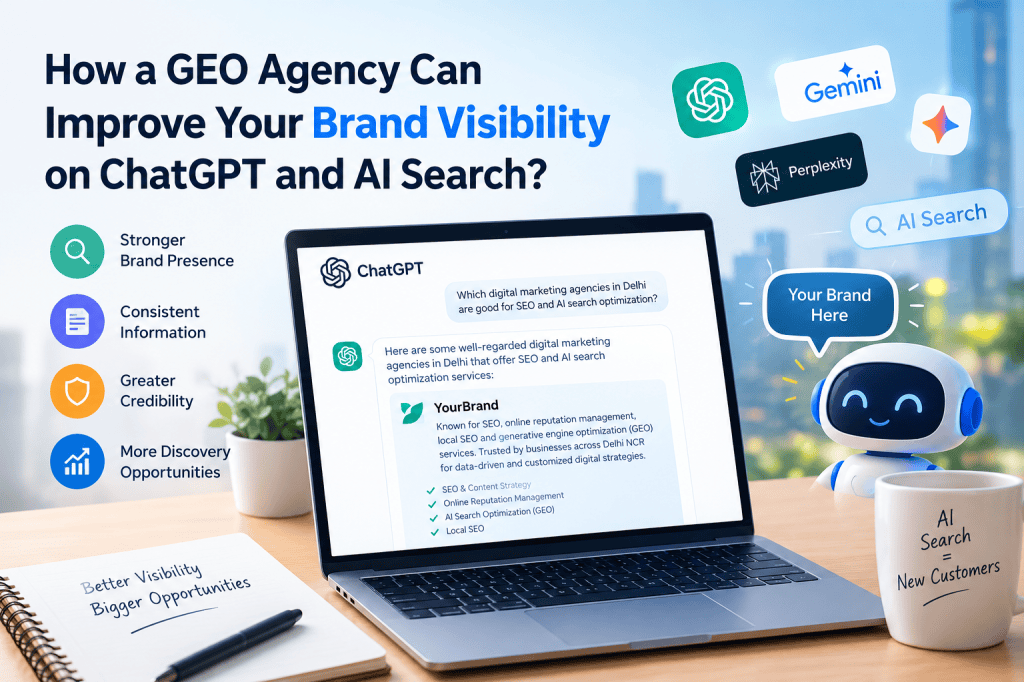
Search is changing.
For years, businesses focused primarily on appearing on Google’s traditional search results. They worked on keywords, backlinks, technical SEO, and content to bring their websites closer to the top of search pages.
Today, people are also asking questions directly to AI platforms such as ChatGPT, Gemini, and other generative search tools.
Instead of searching for ten different websites, a user may simply ask an AI tool to recommend a service provider, explain a product, compare companies, or suggest solutions to a particular problem.
This shift has created a new challenge for businesses: How can a brand become visible when customers are searching through AI-generated answers?
This is where a GEO agency can help.
What Is GEO?
GEO stands for Generative Engine Optimization. It refers to the process of improving a brand’s online presence so that its information is easier for generative AI systems and answer engines to understand, interpret, and potentially reference.
Traditional SEO generally focuses on improving visibility in search engine results.
GEO takes a broader approach by considering how information about a business is presented across the web and how that information may be interpreted by AI-driven search systems.
It does not mean there is a guaranteed method for making a brand appear in every ChatGPT or AI search response. Instead, the focus is on building a strong, clear, trustworthy, and well-supported digital presence.
Why AI Search Is Becoming Important for Brands
The way people discover information is becoming more conversational.
A traditional search might look like:
“best digital marketing agency in Delhi”
An AI-oriented query could be:
“Which digital marketing agencies in Delhi offer SEO, reputation management and AI search optimization?”
The second question requires the system to understand several things at once.
It needs to identify businesses, understand their services, interpret the user’s requirements, and potentially use information from multiple sources.
This creates a new opportunity for brands that have clear and consistent information available online.
A GEO Agency Helps Build a Stronger Information Ecosystem
One of the key differences between traditional SEO and GEO is the importance of information beyond a single website.
AI systems may encounter information about a company through its website, business listings, publications, industry websites, reviews, social profiles, directories, and other online sources.
If these sources provide conflicting or incomplete information, understanding the brand can become more difficult.
A GEO agency can therefore examine the broader online presence of a business and identify areas where its information needs improvement.
This may include:
- Brand descriptions
- Service information
- Company profiles
- Authoritative content
- Industry mentions
- Business listings
- Reviews and reputation signals
- Structured website information
- Third-party references
- Frequently asked questions
The objective is to create a more consistent digital footprint.
Clear Content Gives AI Systems Better Context
Good content has always been important for SEO. With AI search, clarity becomes even more valuable.
A page should make it easy to understand:
- What the company does
- Who it serves
- Which services it provides
- What problems those services solve
- Where the company operates
- What makes its offering different
- What evidence supports its claims
For example, instead of creating a page that repeatedly uses a keyword such as “GEO services in India,” a business can create a useful resource explaining what generative engine optimization means, how it differs from SEO, what businesses should consider, and what realistic outcomes to expect.
Such content provides context rather than simply repeating keywords.
GEO Is Not Just About Adding AI-Related Keywords
A common misunderstanding is that GEO means inserting terms such as “ChatGPT,” “AI search,” and “generative search” into every page.
That approach misses the larger picture.
AI systems need meaningful information.
If a website contains vague statements, unsupported claims, repetitive content, or pages created mainly to manipulate search visibility, adding more AI-related keywords will not solve the underlying problem.
A more useful approach is to build content around genuine questions.
For example:
What is Generative Engine Optimization?
How is GEO different from traditional SEO?
How can businesses prepare for AI search?
What information helps customers evaluate a company?
How should brands structure service information for better understanding?
These questions can become the foundation of useful, people-first content.
Entity Understanding Can Matter More Than Keyword Repetition
Traditional SEO often encourages businesses to think about individual keywords.
GEO requires a broader way of thinking.
A brand is not simply a collection of keywords. It is an entity associated with particular services, locations, people, products, industries, and topics.
For example, if a company provides SEO, online reputation management, local SEO, AEO, and GEO services, its online content should clearly communicate those relationships.
The website, business profiles, articles, publications, and other legitimate references should ideally describe the business consistently.
This can make the overall digital presence easier for search and AI systems to interpret.
Building Third-Party Authority Can Support Brand Discovery
A company’s own website is only one source of information.
Independent and third-party sources can also contribute to how a brand is perceived online.
Relevant industry publications, interviews, expert articles, business directories, professional profiles, and genuine mentions can help establish a wider presence.
However, quantity should not be confused with authority.
Publishing hundreds of low-quality articles or creating large numbers of irrelevant backlinks does not automatically create credibility.
A GEO strategy should focus on relevance, usefulness, consistency, and genuine recognition rather than producing content simply for the sake of creating more mentions.
Structured Information Helps Search Engines Understand Businesses
Technical SEO remains relevant even when the discussion moves toward AI search.
Well-organized website architecture, descriptive page titles, internal links, structured data where appropriate, crawlable pages, and clear business information can all help search systems process website content.
For local businesses, information such as the business name, location, contact details, services, and opening hours should be kept accurate and consistent.
GEO does not replace SEO.
In many cases, it builds on the technical and content foundations that good SEO already requires.
FAQs Can Address Conversational Search Behaviour
People often use AI tools in a question-and-answer format.
That makes FAQs particularly useful for businesses.
A well-written FAQ section can address practical customer questions about pricing, services, processes, locations, timelines, limitations, or eligibility.
The answers should be written for people rather than designed as collections of keywords.
For example, instead of:
“What are the best GEO services in India?”
followed by a promotional paragraph, a company could answer a genuine question such as:
“How does GEO differ from SEO?”
A clear answer can help potential customers understand the service before they decide whether they need it.
Reputation Can Influence How a Brand Is Understood
AI search visibility is not purely a content problem.
A brand’s broader online reputation can also matter.
If a company has inconsistent information, unresolved customer complaints, weak business profiles, or limited independent references, it may have a harder time presenting a strong and coherent digital identity.
This is why GEO can overlap with other areas of digital marketing, including:
- Online Reputation Management
- Review Management
- Local SEO
- Content Marketing
- Digital PR
- AEO
- Technical SEO
These activities can work together to create a more complete online presence.
Measuring GEO Requires a Different Mindset
Traditional SEO reporting often focuses on rankings, impressions, clicks, and organic traffic.
Those metrics remain useful, but AI search creates additional questions.
Businesses may want to monitor:
- How their brand is described in AI-generated responses
- Whether important services are understood correctly
- Which sources are associated with their brand
- How competitors are represented
- Whether brand information is consistent across platforms
- Which questions potential customers ask about the industry
- Whether AI-generated descriptions contain outdated or inaccurate information
AI responses can change depending on the platform, query, location, context, available sources, and other factors. Therefore, businesses should avoid treating a single AI response as a permanent ranking position.
What Should Businesses Look for in a GEO Agency?
Before hiring a GEO agency, businesses should understand exactly what the agency intends to do.
Useful questions include:
How will you evaluate our current AI search visibility?
How will you improve the clarity of our brand information?
What type of content will you create?
How will you strengthen relevant third-party mentions?
How will you coordinate GEO with our existing SEO strategy?
How will you monitor AI-generated brand references?
What metrics will you use to measure progress?
These questions can help separate a genuine optimization strategy from a package built around buzzwords.
The Future of Search Is Becoming More Conversational
The growth of AI-powered search does not mean traditional search engines are disappearing.
Instead, users now have more ways to discover information.
Someone may find a business through Google, Google Maps, a social platform, a review website, an industry publication, or an AI assistant.
For brands, this means the quality and consistency of their digital information matter across multiple channels.
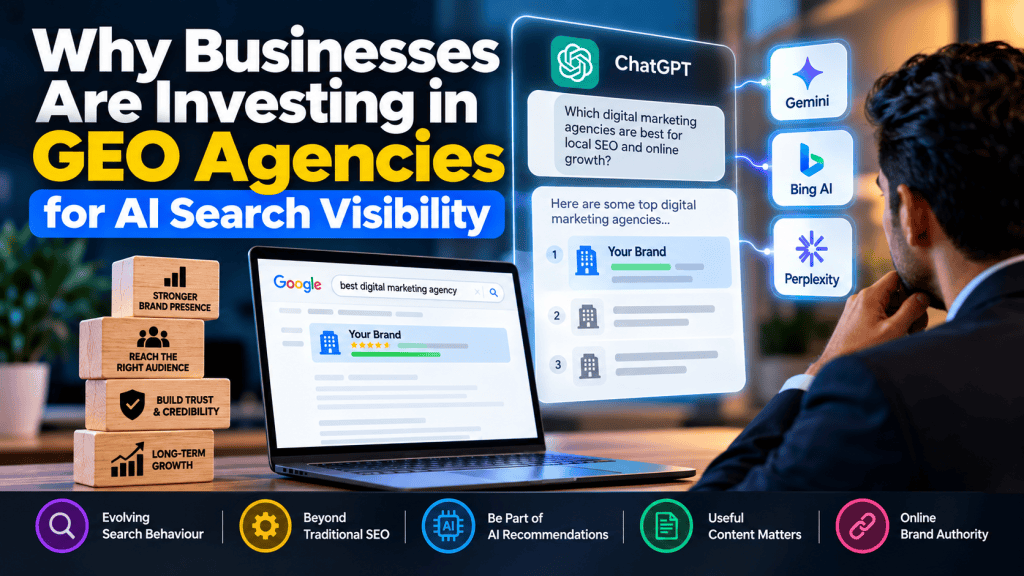
A GEO agency can help businesses adapt by making their content clearer, strengthening their digital footprint, improving information consistency, and identifying opportunities to become a more useful source of information within their industry.
Final Thoughts
Visibility in AI search cannot be achieved simply by adding a few AI-related keywords to a website.
It requires a broader approach to digital presence.
Businesses need clear information, useful content, credible references, consistent brand signals, strong technical foundations, and an understanding of the questions their customers are asking.
A professional GEO agency can bring these elements together and help a brand prepare for an increasingly conversational search environment.
The goal is not to chase every AI-generated answer.
It is to build a digital presence that is clear enough to understand, useful enough to reference, and trustworthy enough for customers to take seriously.


Leave a Reply